 Crochet Home & Kitchen Decor
*This post may contain affiliate links to support the cost of this blog. At no cost to you, I may make a small commission if you purchase through these links. Read our Privacy Policy HERE
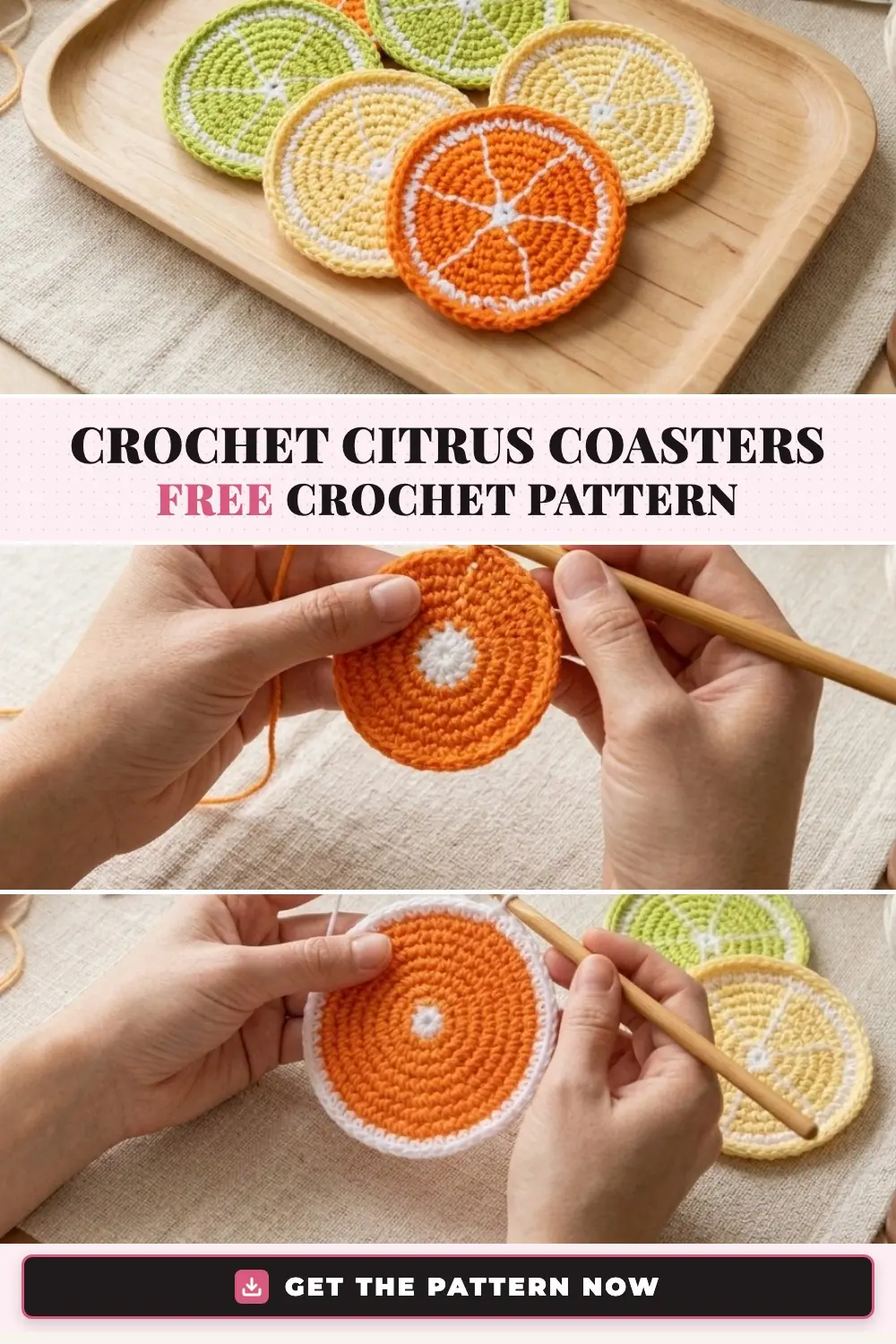
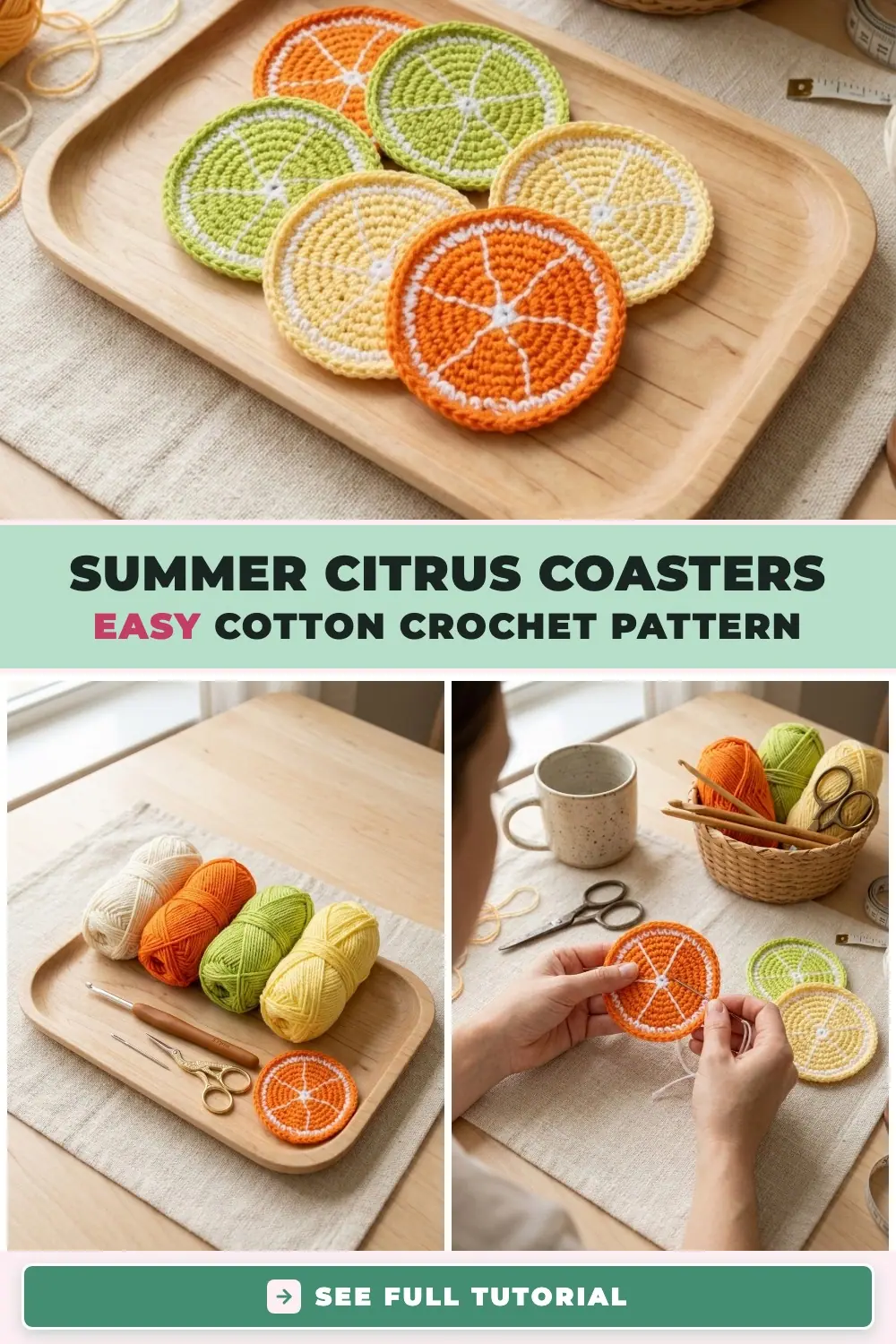
There is something undeniably cheerful about setting a chilled glass down on a handmade coaster that looks just like a freshly cut slice of summer citrus. The first time I hooked up a set of these Crochet Citrus Slice Coasters, my kitchen table went from everyday-ordinary to bright and welcoming in a single afternoon. Whether you love the zesty pop of lime green, the sunny glow of lemon yellow, or the warm vibrancy of tangy orange, this beginner-friendly pattern turns classic single crochet stitches into practical table decor.
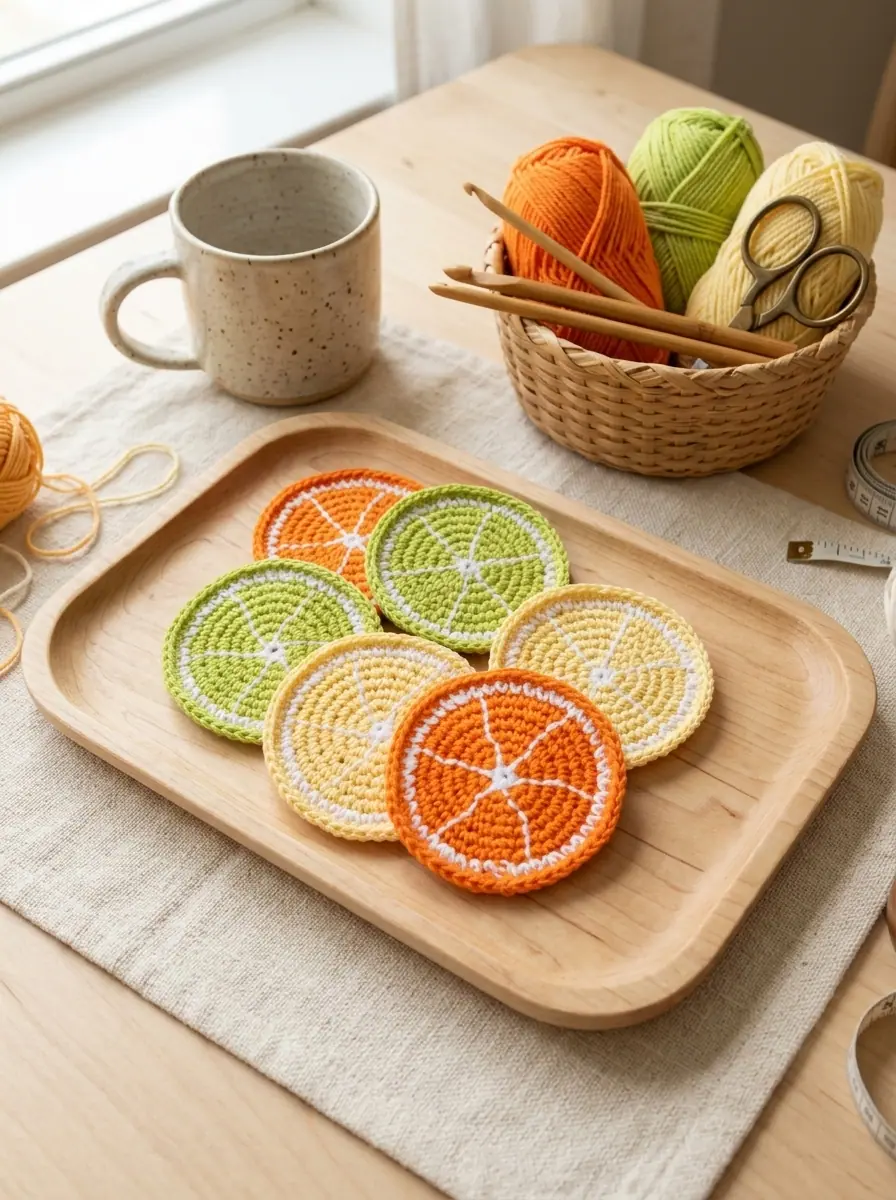
What makes this project such a pleasure to crochet is its simple, clever color construction. You begin right at the center with a neat ring of crisp white cotton, build outward in joined rounds of bright fruit color, frame the slice with a contrasting white pith round, and finish the edge with a vibrant outer rind. Once your flat circle is off the hook, six straight lines of white back-stitch embroidery divide the coaster into realistic citrus wedges.
Pattern Overview
- Skill Level: Beginner (Worked flat in joined rounds using basic single crochet)
- Finished Measurement: Approx. 4½” [11.5 cm] in diameter
- Yarn Weight: Medium #4 (100% Worsted Weight Cotton)
- Recommended Hook: Size U.S. F/5 (3.75 mm) crochet hook, or size needed to obtain gauge
- Gauge: 16 single crochet (sc) and 17 rows = 4″ [10 cm]
- Pattern Yield: 1 ball of Contrast A (White) + 1 ball of Contrast B (one citrus shade) makes approx. 6 coasters of a single color. To make a mixed 3-color citrus set (orange, lemon, and lime as pictured), you will need 1 ball of White plus 1 ball of each of the 3 citrus shades (4 balls total, with plenty of yarn left over for extra coasters).
Table of Contents
Yarn and Materials Needed
For coasters that absorb condensation from cold drinks and handle everyday kitchen use, 100% worsted cotton yarn is strongly recommended for its natural absorbency and heat tolerance. Working worsted weight cotton with the recommended 3.75 mm (US F/5) hook—and matching the stated gauge—helps produce a dense, firm fabric with minimal gaps between stitches.
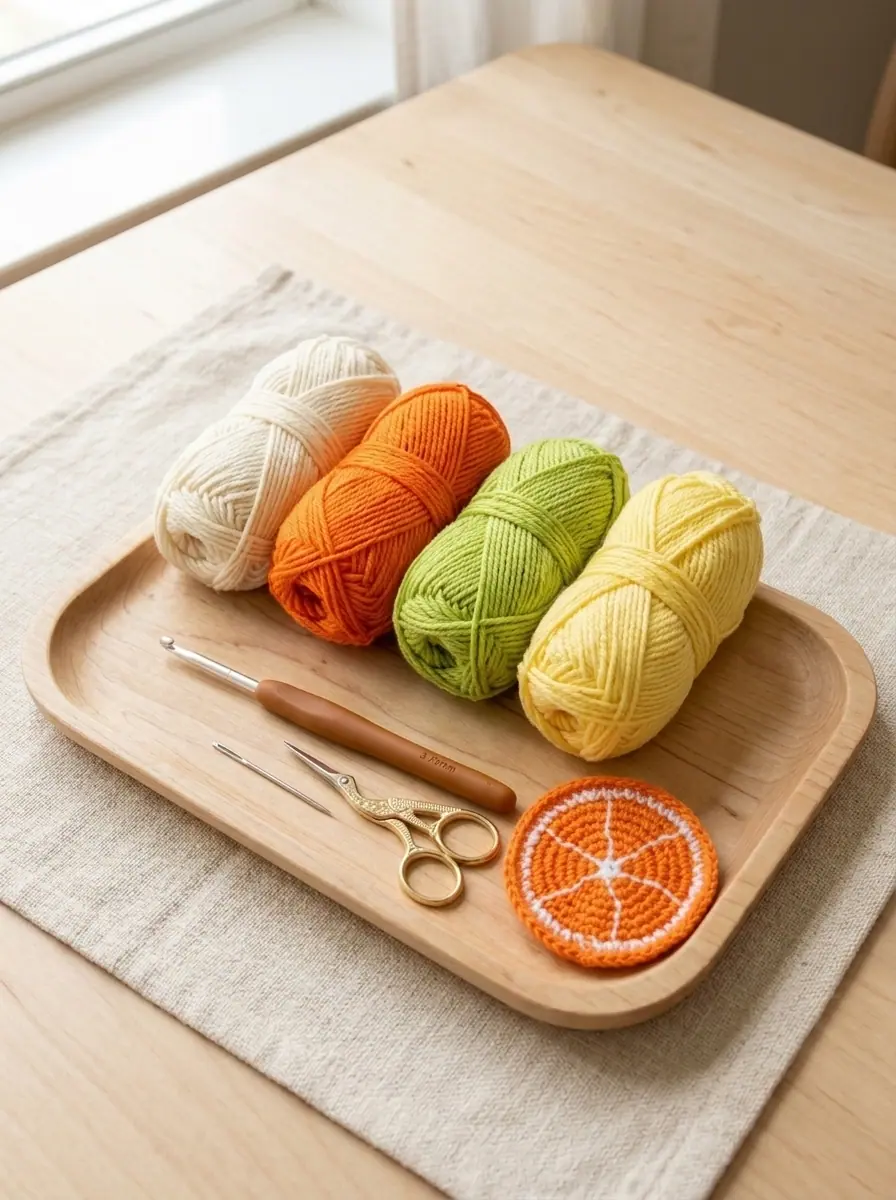
Yarn: Lily® Sugar’n Cream® (100% Worsted Cotton; 2.5 oz / 70.9 g; 120 yds / 109 m per ball):
Contrast A (Center, Pith & Embroidery): White (00001) — 1 ball.
Contrast B (Citrus Flesh & Outer Rind): Hot Green (01712) or Yellow (00010) or Hot Orange (01628) — 1 ball (Note: 1 ball of A and 1 ball of B will make approx. 6 coasters; use 1 ball of each citrus shade if making a multi-color assortment, or use worsted cotton scrap yarn).
Crochet Hook: Size U.S. F/5 (3.75 mm) crochet hook, or size needed to obtain gauge.
Notions: Blunt-tipped tapestry or yarn needle (for back-stitch segment embroidery and weaving in ends) and small crafting scissors.
Crochet Stitches and Abbreviations (US Terms)
This pattern is written in standard US crochet terminology. Review the abbreviations below before starting your foundation chain:
| Abbreviation | Stitch Meaning & Definition |
|---|---|
| Approx | Approximate(ly) |
| Ch | Chain(s) |
| Rep | Repeat |
| Rnd(s) | Round(s) |
| Sc | Single crochet |
| Sl st | Slip stitch |
| Sp(s) | Space(s) |
| St(s) | Stitch(es) |
| Tog | Together |
| Yoh | Yarn over hook |
✨ FREE CROCHET EBOOK ✨
Master Gauge & Blocking
Get Our Free Crochet Ebook!
Download The Ultimate Stitch, Gauge & Blocking Guide — packed with printable stitch charts, tension secrets, and step-by-step tutorials delivered straight to your inbox.
🔒 100% Free Instant PDF Download • Unsubscribe anytime
Step-by-Step Citrus Slice Coaster Pattern
Each coaster is worked flat in joined rounds from the center outward. Rather than stacking increases in the exact same spot every round—which can cause a crochet circle to take on hexagonal corners—this pattern staggers where the 2 sc increase falls on Rounds 4, 6, 7, and 8 so the coaster keeps a smooth, round edge.
Maker Tip for Clean Color Changes: When the pattern states “Join B with sl st to first sc,” insert your hook into the first stitch of the round, yarn over with the new color, and draw through both loops on your hook to complete the slip stitch. Because Round 1 is at the very center of the coaster and Contrast A (White) is not used again until Round 8 near the outer edge, cut and fasten off Contrast A after Round 1 (leaving a tail to weave in) rather than carrying it across the back, then join a fresh strand of Contrast A at the end of Round 7.
Part 1: The White Center and Citrus Flesh (Rounds 1–7)
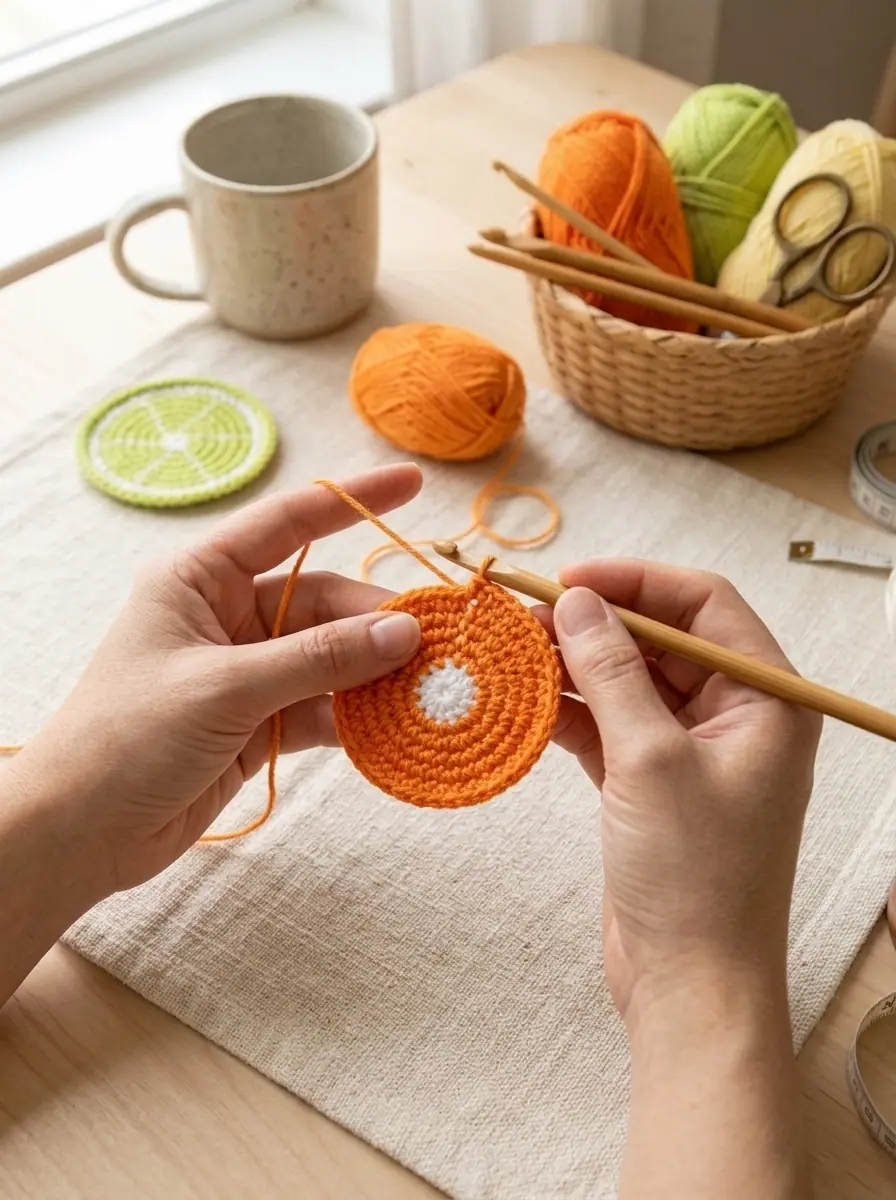
Begin at the center using Contrast A (White) for Round 1, then join Contrast B (your chosen orange, lemon, or lime shade) to work Rounds 2 through 7 until the citrus interior reaches 42 single crochet stitches.
Foundation: With A, ch 2.
1st rnd: 6 sc in 2nd ch from hook. Join B with sl st to first sc. Fasten off A. (6 sc)
2nd rnd: With B, ch 1. [2 sc in each sc] — repeat […] around. Join with sl st to first sc. (12 sc)
3rd rnd: Ch 1. [1 sc in next sc. 2 sc in next sc] — repeat […] around. Join with sl st to first sc. (18 sc)
4th rnd: Ch 1. [2 sc in next sc. 1 sc in each of next 2 sc] — repeat […] around. Join with sl st to first sc. (24 sc)
5th rnd: Ch 1. [1 sc in each of next 3 sc. 2 sc in next sc] — repeat […] around. Join with sl st to first sc. (30 sc)
6th rnd: Ch 1. [1 sc in each of next 2 sc. 2 sc in next sc. 1 sc in each of next 2 sc] — repeat […] around. Join with sl st to first sc. (36 sc)
7th rnd: Ch 1. [2 sc in next sc. 1 sc in each of next 5 sc] — repeat […] around. Join a new strand of A with sl st to first sc. (42 sc)
✨ PATTERN HELP & TIPS ✨
Got Questions?
Frequently Asked Questions
Click on any question below to reveal the answer
What yarn works best for crochet coasters?
100% unmercerized medium weight (#4) cotton yarn like Lily Sugar’n Cream is ideal because cotton absorbs condensation from cold glasses, holds its flat round shape, and is machine washable.
Why are my crochet coasters curling at the edges?
Curling happens if your stitch tension is too tight on Round 3 or Round 4. Try going up a half hook size (to 5.5 mm) or steam-blocking the finished coasters flat under a damp towel.
Can I make lemon, lime, and grapefruit slices with this same pattern?
Yes! Use bright yellow for lemon, key lime green for lime, or coral pink for ruby grapefruit—the stitch counts and white pith embroidery lines stay 100% identical.
Would you like to save this pattern?
Enter your email below and we will send this free crochet pattern directly to your inbox so you never lose it!
Your privacy is protected. Unsubscribe with 1-click anytime.
Part 2: The White Pith Ring and Outer Rind (Rounds 8–9)
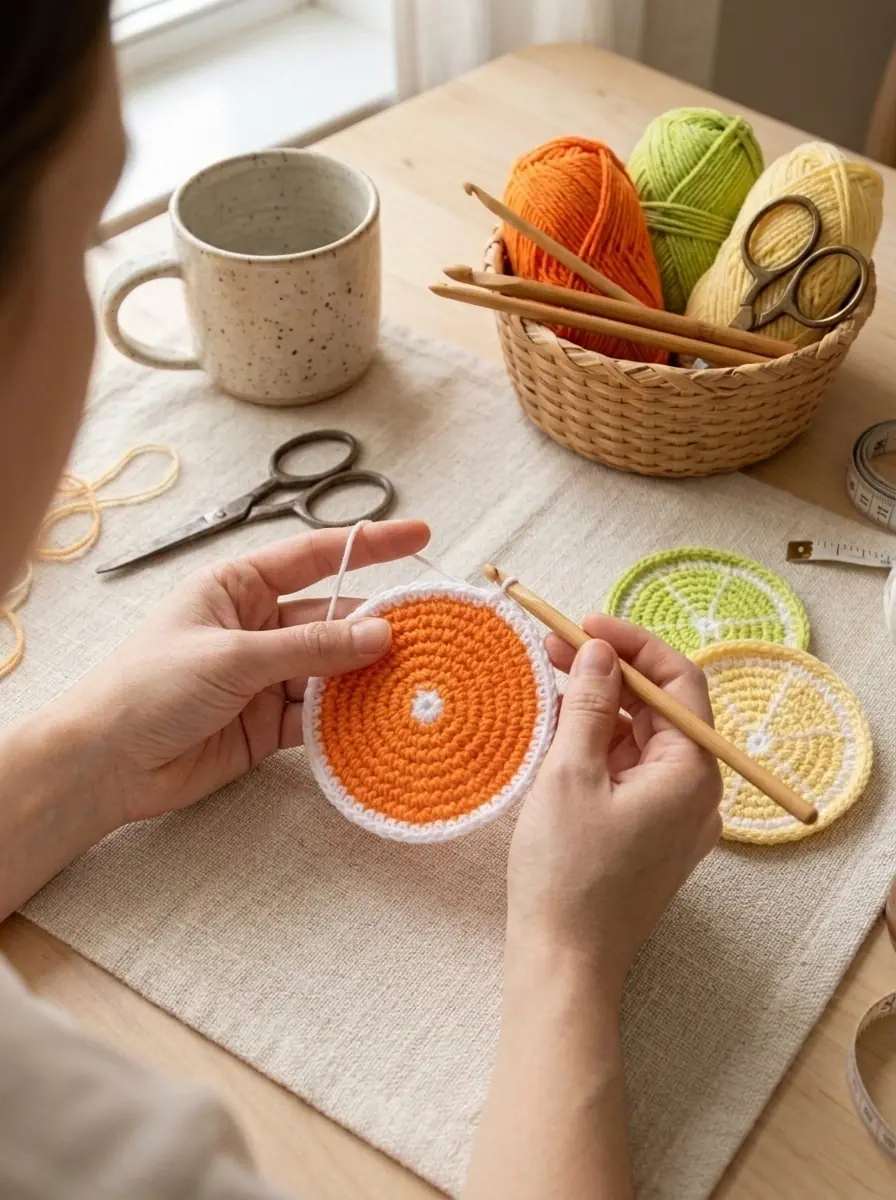
With your 42-stitch fruit center complete and Contrast A (White) joined at the end of Round 7, work Round 8 in White to create the contrasting citrus pith ring. You can carry Contrast B loosely up the inside of this single round so it is ready to join at the end of Round 8, then cut Contrast A (Break A) and finish Round 9 in Contrast B for the outer peel.
8th rnd: With A, ch 1. [1 sc in each of next 3 sc. 2 sc in next sc. 1 sc in each of next 3 sc] — repeat […] around. Join B with sl st to first sc. Break A. (48 sc)
9th rnd: With B, ch 1. [1 sc in each of next 7 sc. 2 sc in next sc] — repeat […] around. Join with sl st to first sc. Fasten off. (54 sc)
Finishing and Back-Stitch Segment Embroidery
Once Round 9 is fastened off at 54 stitches (measuring approx. 4½” [11.5 cm] in diameter), add the embroidered segment lines that turn the two-tone circle into a realistic citrus slice.
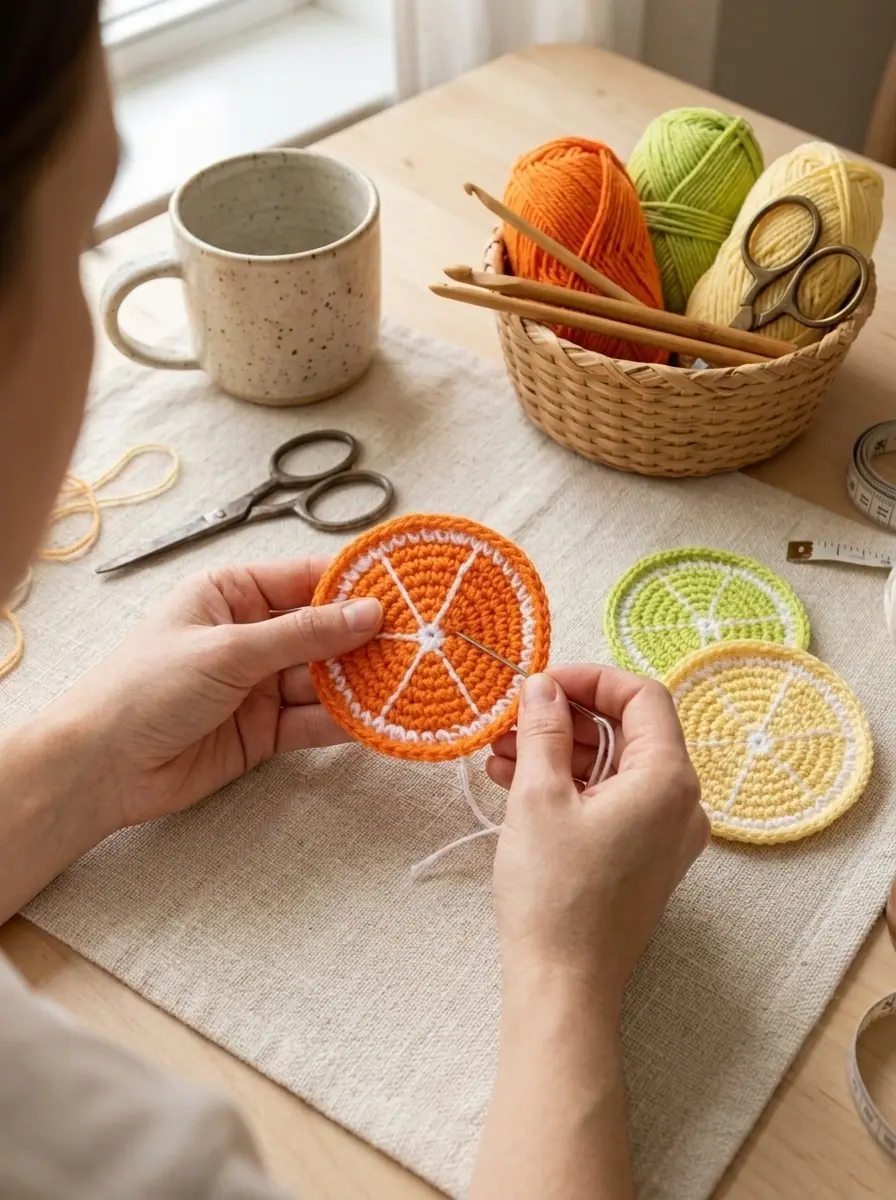
Step 1 — Space the 6 Citrus Segments: Thread a comfortable working length of Contrast A (White) onto your tapestry needle (use additional strands as needed so you never have to pull tight). The original pattern features 6 evenly spaced segment lines radiating from the white center (Round 1) out to the white pith ring (Round 8). Because Round 7 has 42 stitches and Round 8 has 48 stitches, spacing your 6 lines every 7 stitches at the outer edge of Round 7 (or every 8 stitches along Round 8) divides the circle into 6 symmetrical wedges. (Optional Variation: If you prefer 8 smaller citrus wedges instead of the 6 shown in the original pattern, space 8 lines every 6 stitches along Round 8.)
Step 2 — Work the Back Stitch: Following the pattern’s Back Stitch diagram, bring your needle up from the wrong side to the right side at the edge of the white center (point 1). Insert the needle one stitch-length backward (point 2) and bring it up one stitch-length ahead along the same radial line (point 3). Continue working straight back-stitches outward until the line meets the white pith of Round 8.
Step 3 — Weave In Ends: Keep your embroidery tension relaxed so the coaster lies flat without puckering. Once all 6 segment lines are complete, weave all yarn tails securely into the wrong side of the work and trim any excess yarn.
Official Yarn Care Instructions
To keep your Lily® Sugar’n Cream® 100% cotton coasters looking bright and holding their shape, follow the manufacturer’s official care guidelines for this yarn:
- Wash Colors Separately: Bright cotton shades (especially Hot Orange and Hot Green) should be washed separately from lighter laundry on the first few washes.
- Gentle Machine Wash: Machine wash in lukewarm water (30°C / 86°F maximum) on a delicate cycle.
- No Bleach: Do not bleach, as bleaching agents can weaken cotton fibers and fade the citrus colors.
- Drying & Shaping: Reshape your coasters into flat circles while damp and lay flat to air-dry, or tumble dry on low heat according to the yarn label.
- Do Not Iron or Press: Per the official Lily® Sugar’n Cream® care instructions, do not iron, press, or steam with an iron, which preserves the natural loft and texture of the single crochet stitches.
Save This Crochet Pattern to Pinterest
Want to make these cheerful summer coasters later? Pin one of the images below to your favorite crochet board on Pinterest so you always have this free pattern handy!
PREVIOUS PATTERN
Nine-Point Striped Crochet Christmas Tree Skirt With Red Pompoms
NEXT PATTERN
Ribbed Rustic Autumn Crochet Pumpkins With Cinnamon-Stick Stems
✨ KEEP CROCHETING ✨
You May Also Love
LEAVE A COMMENT
Have a question about a stitch or want to share how your project turned out? Drop a comment below — I read and reply to every maker!